

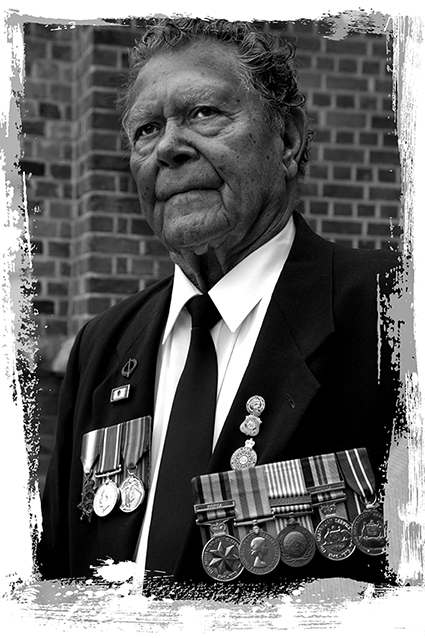
“My father was in the First World War; my brother was in the Second World War and Korea. I have five uncles – six uncles – in the Second World War. One was killed in New Guinea just before the war finished. They were all discriminated against. They weren’t allowed in to have a drink with their mates that they fought alongside. And even on Anzac Day, because you were an Aborigine, you weren’t allowed in the pub with your mates. We were fighting in jungles and deserts with all our mates, all together. Then when you come back here, just nothing. A lot of white Australians got soldier settlement farms, not the case for Aboriginals.”
– Leonard Ogilvie
Leonard Ogilvie
Yamatji Man
Private
3rd Battalion, Royal Australian Regiment
Royal Australian Infantry Corps
Australian Army
Medals
Australian Active Service Medal 1945-75 with clasp Korea
Australian General Service Medal for Korea
United Nations Service Medal (Korea)
Australian Service Medal 1945-75 with clasp Korea
Australian Defence Medal
Infantry Combat Badge
“I was born on ANZAC Day in Northampton in 1928.
Between 1930-1939, I was taken with my two brothers from our family to the Moore River settlement. I went to school in an old church, the teachers were only teacher aides who rammed the bible down my throat every day. That was the extent of my education. I slept on bug-infested mattresses with a blanket that you could see through. When visitors came from Perth, they put sheets and pillow slips on the beds, then put them back into store when they left. They sent my brothers to another mission down south in Bunbury but I was left because I wasn’t old enough to leave school. It wasn’t easy for me.
I spent six and a half years in that institution and when I was old enough, I was sent out to work on farms and sheep stations, until I got a government job. In that time I’d seen my mother once in 10 years and my father (who was wounded in WWI on the Western Front), probably twice in 10 years.
I joined the army in 1948 as an Infantry soldier and spent a couple of years at Puckapunyal as an Infantry driver until I left for Korea. For five weeks I was in and out of combat as a Bren Gun Carrier driver. Conditions weren’t the best, we slept in fox holes and sometimes the rations didn’t turn up and you had to dig in especially at night, no talking, no smoking.
We were attacked on 5th November 1950 and I was badly wounded. I spent all night behind enemy lines. That was stressful. The next morning, I was lucky I didn’t get shot because just before the F-80s came in and strafed the area, I was picked up by the stretcher-bearers. They came through in the American General Grant tanks, picking up the wounded and dead. I was strapped on the back of the tank and taken to the field hospital. The next thing, I woke up in a Japanese hospital, then taken to the Perth Army hospital. Altogether I was in hospital for about three months. I was no further use for combat because of that injury, so that was the end of my career as an infantry soldier. After I recovered, I was posted to Western Command as a driver and finished my last four years of service driving a staff car for the Brigade Commanders in Perth.
I haven’t suffered PTSD. It’s a wonder, though; sometimes I wake up at night, something you do when you’re wounded in the army, you have nightmares. In 2008 I was one of two ex-Diggers from Western Australia chosen to go to South Korea for the Anniversary of the Korean War. I’ve marched on most ANZAC days since 1966 until 2014 when I was taken in the Jeep. I never regretted joining, it was a good life.”
– Leonard Ogilvie