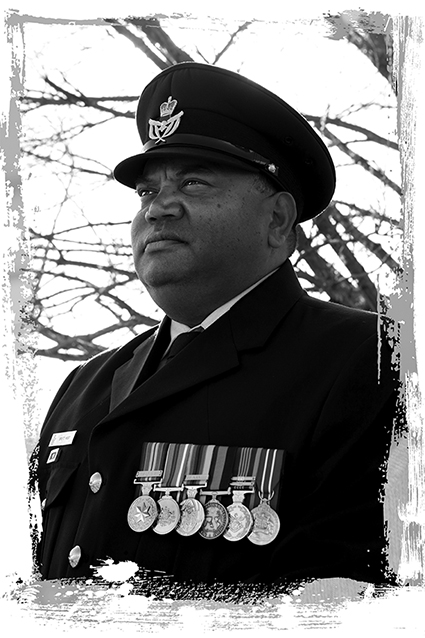
Brett West
Yamatji Man
Warrant Officer
Royal Australian Air Force
Medals
Australian Active Service Medal with clasp ICAT
Afghanistan Medal
Australian Service Medal with clasp SE Asia
Australian Operational Service Medal – Border Protection
Defence Long Service Medal with 2nd clasp
Australian Defence Medal
Meritorious Unit Citation – 92 WG ICAT
“I am a Yamatji man, born in Western Australia; my heritage comes from the Nhanda, Malgana and Yinggarda language groups. I grew up in the small town of Carnarvon, in the north-west of Western Australia, about 900 kilometres north of Perth, enjoying the love and care of my mother’s extended Aboriginal family.
My family then moved to Perth, where I did my secondary schooling, and on completion of Year 12, I joined the Royal Australian Air Force (RAAF). I enjoyed my time at No 1 Recruit Training Unit, everyone was equal, treated the same and expected to ‘pull their weight’. This was refreshing as I had been subjected to a fair bit of racism in my youth.
After recruit training I was posted to RAAF Base Wagga for my aircraft fitter/technician training at the RAAF School of Technical Training. While I enjoyed the training, I started to feel homesick. I initially thought it was just missing home but soon became aware I was missing not only family, but the cultural safety of having other Aboriginal people around me. After completing my training, I was offered the opportunity to become an Armament Fitter (working on aircraft weapons systems, explosives and small arms weaponry.
My first posting was to RAAF Base Williamtown (WLM) in Newcastle, No 77 Squadron, on Mirages and then F/A-18 Hornets. During this posting, the Commanding Officer asked if I would be willing to represent the squadron at Leonard Waters’s funeral, the first Aboriginal fighter pilot. I accepted and found this was not only an honour but started me thinking about how successful Aboriginal people provided important role modelling for Aboriginal youth. While still at RAAF WLM, I was posted to No 2 Operational Conversion Unit, a squadron that trained pilots to fly F/A-18s, and then No 402 Wing Field Training Flight which was an Air Force technical school that trained technicians to work on F/A-18s.
My next posting (as a flight sergeant) was to Defence Establishment Orchard Hills (DEOH) to a unit called Precision Guided Munitions – Technical Maintenance Facility, which specialised in maintenance on guided missiles.
I then went to No 79 Squadron at RAAF Base Pearce, back to my home state and, again, involved in pilot training. As the posting was back in Perth, I was close to family and was able to go back to my Country for what I would describe as a cultural reinvigoration. While at first this was great, I found being back also involved me having cultural obligations I had not been exposed to before. Balancing these expectations along with the expectations of the Air Force was very tricky and I found the hierarchy of the squadron did not understand I had to ‘walk in two
worlds’ that did not always converge smoothly.
It was then back to Adelaide, to No 10 Squadron, working on the Orion maritime aircraft and for the first time I was operationally deployed. I found the deployments good as I was able to put the training I had been doing for so many years into practice.
Then came a posting back to DEOH to the newly formed Defence Explosive Ordnance Training School as the School Warrant Officer (WOFF). After this, and still at DEOH, I went to Joint Logistics Unit – Regional Explosive Ordnance Services where I performed domestic Explosive Ordnance Disposal duties (think police bomb squad) and inspections of explosive storage areas. My wife then wanted to return to her home state of Victoria, so I discharged to enable our move
For the next number of months, I was employed as a reserve and staff member for the next Indigenous Pre-Recruit Programs until being asked to come back full time into the Air Force, this time to Canberra within the Directorate of Personnel – Air Force. Initially, this posting was great, but I soon found that, while senior leadership understood the idea of inclusion, the management level below them was either not ready or willing to make the changes needed to make Air Force a truly culturally safe employer
Over the three decades I served, I found the Air Force to become more culturally aware and inclusive but there is still a way to go. When I first joined in the mid-80s, I faced blatant and overt racism, moving into the 90s and experiencing occasions of ‘casual’ racism, and going into the 21st century Air Force grappling with wanting to ‘do the right thing’, but not ready to make the big decisions needed to make the organisation a fully inclusive environment.”
– Brett West