

“True leaders move before the crowd does.”
– Gordon Thomas Watts
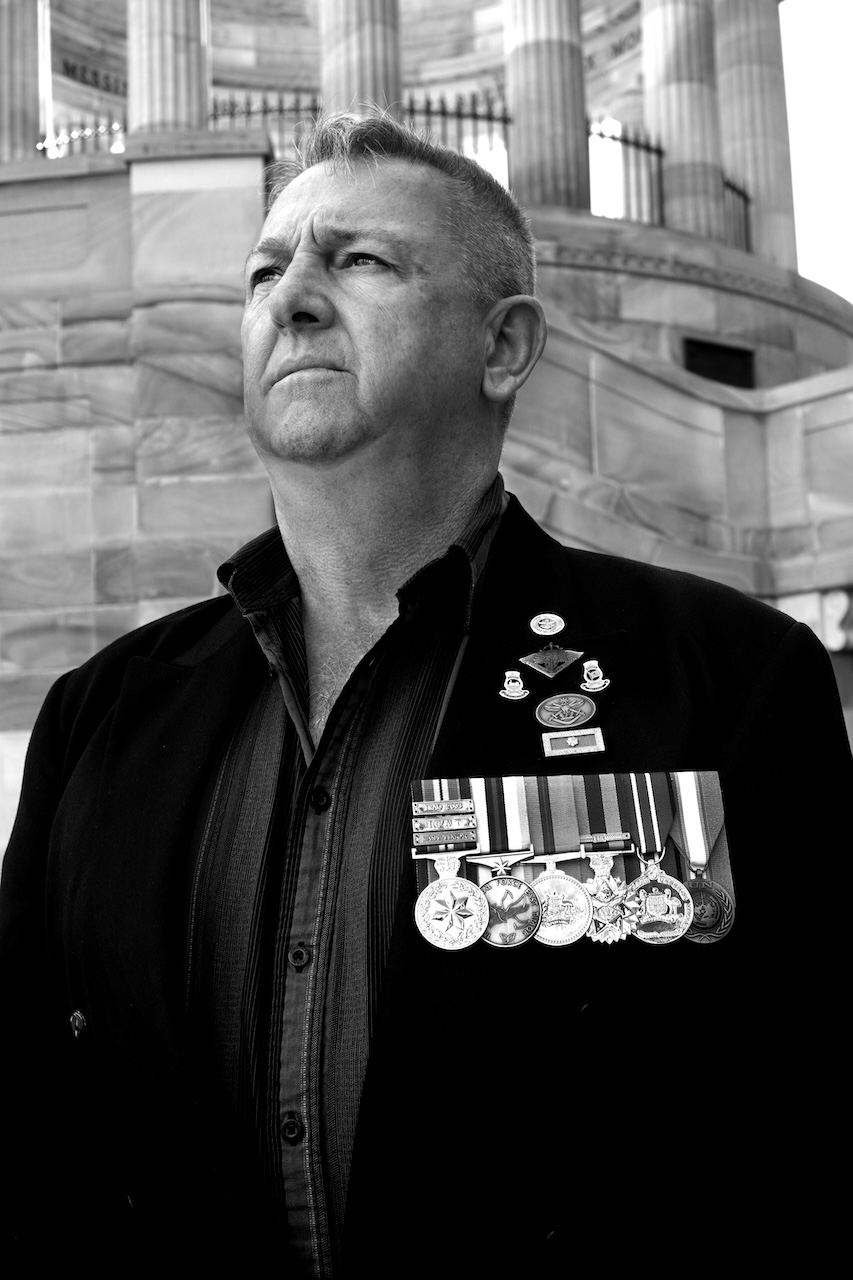
Gordon Thomas Watts
Dharug People – Western Sydney
Warrant Officer Class Two (retired)
Royal Australian Corps of Transport
Australian Army
Medals
Australian Active Service Medal with clasps East Timor, ICAT and Iraq 2003
International Force East Timor Medal (INTERFET)
Iraq Medal
Defence Force Service Medal with 1st clasp
Australian Defence Medal
United Nations Medal East Timor
Meritorious Unit Citation – HMAS Kanimbla
Force Commanders Commendation (UNTAET)
COMD DJFHQ Commendation (Operations Citadel/Stabilise/Warden)
Returned from Active Service Badge
“I served with the Australian Army in the Royal Australian Corps of Transport from November 1983 through to my retirement from active service in November 2004. During my time in the Army, I served as a Cargo Specialist which saw me posted to on shore units such as 30 Terminal Squadron, Singleton Movement & Transport Unit, 10 Force Support Battalion and Deployed Forces Support Unit – Darwin, as well as at sea with the Australian Antarctic Division onboard the icebreaker MV Icebird, the Royal Australian Navy onboard HMAS Jervis Bay as the Load Master for Operations Citadel, Stabilise and Warden, and then onto HMAS Kanimbla as the Ship’s Sergeant Major (SSM) in support of Operation Tanager.
I was raised in and around St Marys NSW and I am a proud descendant of Maria Lock of the Dharug People – Western Sydney. Maria was the daughter of Yarramundi, a respected chief of the Richmond tribes and belonged to the Boorooberongal clan of the Dharug people. The first and only ‘body farm’ (to scientifically study the decomposition of human remains) outside the USA, lies at the foot of the Blue Mountains, it was named ‘Yarramundi,’ after Maria’s father.
In December 1814, Maria attended the first meeting between Governor Macquarie and Aboriginal peoples. On that same day Maria became the first student of the Parramatta Native Institution. She was a highly advanced and gifted student reportedly doing well ahead of her European classmates, winning a major scholastic prize and was given the name Maria Cook. Governor Lachlan Macquarie promised Maria a portion of land as a reward for her efforts as a model student.
Maria’s brother Colebee had been kidnapped by Governor Arthur Phillip along with Bennelong at Manly cove. Colebee escaped after three weeks. He eventually became a guide and mediator for Governor Phillip and accompanied him, and William Cox when he constructed the road across the Blue Mountains and many other locations.
In 1822 Maria married Dicky, son of the renowned Bennelong and a member of the Richmond clan. Dicky became ill and died within weeks of the marriage.
Maria then married Robert Locke, an illiterate European convict. He was a carpenter working on the construction of the new Native Institution at Blacktown. This was the first officially sanctioned Aboriginal / British union within the colony; this first interracial marriage taking place at St. John’s church in Parramatta on the 26th of January 1824. However, the official endorsement of this British–Aboriginal marriage was not the only colonial ‘first’ that day. Since Robert had four years of his seven-year sentence yet to serve, the colonial government formally assigned him to his wife’s supervision and care, and she was granted supervision over her husband’s affairs for the remainder of his sentence and eventually received his land grants as well as her own. Maria was even entitled to return him as unsuitable or unwanted should she be dissatisfied with his performance. Those conditions were likely unique in the history of the convict era; they certainly represented another ‘first’ in New South Wales.
It was not uncommon for Aboriginal families to see more than one relative serve during the First World War and later conflicts. The St Marys War Memorial records the names O, L.J. and J. Locke, representing Olga Cecil, Leslie John, and their father Jerome Locke. These three were only part of a remarkable story: nine immediate members of the Lock(e) family enlisted in the Australian Imperial Force, and among their extended kin at least twenty-one are known to have volunteered, most serving overseas. Every one of them was a grandson or great-grandson of Maria Lock. Their service included some of the earliest enlistments in 1914 and took them to battlefields from Gallipoli to the Somme and Flanders, as well as campaigns in Egypt and Palestine. They filled roles in infantry battalions, tunnelling units, veterinary sections, camel corps, and light horse regiments. What makes their contribution especially significant is the broader context: despite their commitment, Aboriginal men faced constitutional exclusion and racial barriers, with Defence regulations often preventing those not deemed of ‘substantial’ European heritage from joining the AIF. In New South Wales, the Lock family were among the first to endure the violence of colonisation, and the first to resist the loss of their land and step forward to defend it during the 1914–1918 war.”
– Gordon Thomas Watts