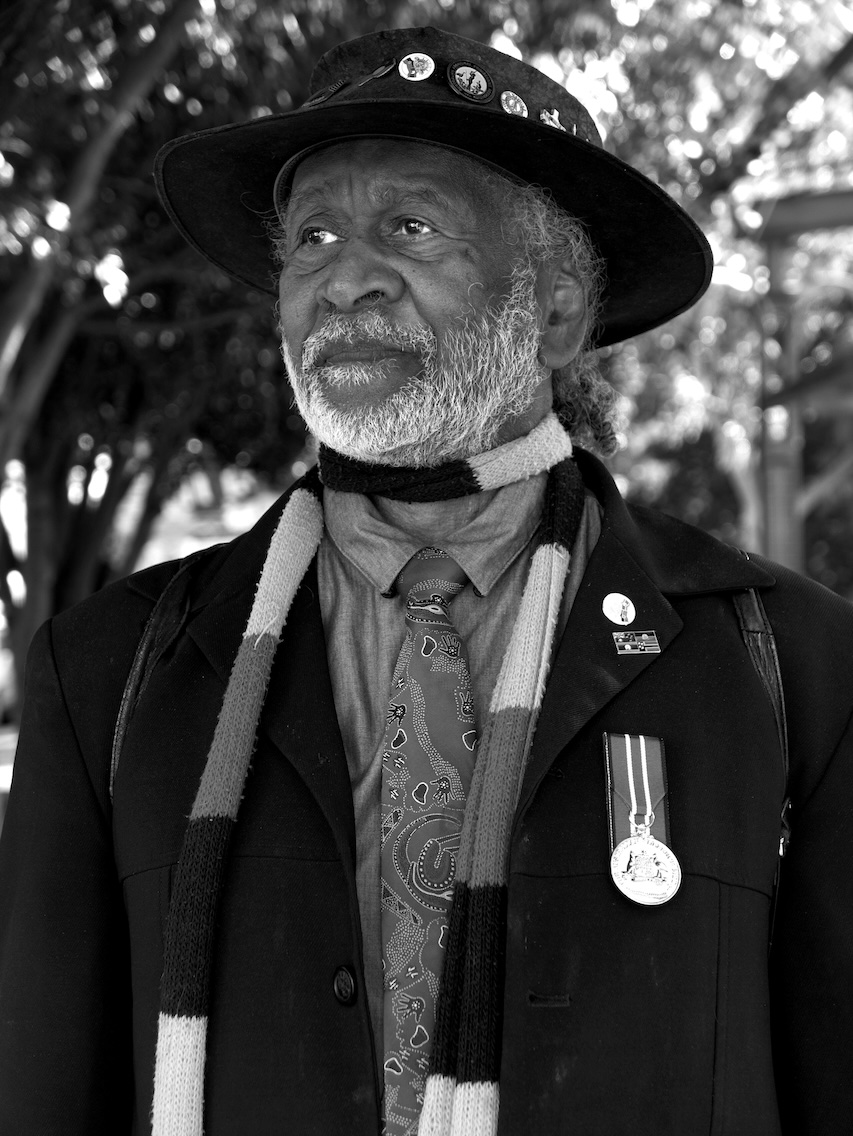
I am an Aboriginal Pastor with ancestral roots in the Kabi-Kabi and Gurang-Gurang tribes of Queensland. I am also a descendant of the South Sea Islander people with connections to the people of Ambrym Island. I live in Sydney and have dedicated my life to supporting members of the Stolen Generations and being the Pastor and founder of Scarred Tree Ministries in Glebe.
I served for two years with the 51st Battalion, Royal Queensland Regiment in the Citizens Military Forces, as transport driver while my two brothers, Sonny and Phillip served in Vietnam. My grandfather Private James Lingwoodock served with the 11th Light Horse Brigade during the Great War. I saw how the service of Aboriginal and Torres Strait Islander veterans was not recognised or respected as much as other veterans. This was not only done by non-Indigenous Australians, but also by a government that quarantined their wages and pensions, prevented their inclusion in schemes that provided returning soldiers with land and job opportunities, and denied them access to military funerals and Returned and Services League (RSL) clubs. I wanted to find a way to draw attention to the contribution made by Aboriginal and Torres Strait Islander people to our country through the Australian Defence Force and so in 2006, along with Chris Carbin, we co-founded the Coloured Digger Project. We thought a march on ANZAC Day, dedicated to recognising the service of Aboriginal and Torres Strait Islander people, would be a good way to make the general population aware of their contribution and give them their due honours, recognition, and respect.
The Coloured Digger Project takes its name from a Second World War poem written by Combat Engineer, Bert Beros, a nonAboriginal serviceman who wanted to pay tribute to Aboriginal servicemen who served with him on the Kokoda Track. The poem is inspired by soldier Harold West, a Murrawarri man. West, along with his friend George Leonard (Euahlayi Nation) enlisted together on 23 August 1941 and were posted to the 2/1st Battalion serving in the Middle East, Ceylon, and Papua New Guinea. When Leonard was killed in action in 1942 while serving along the Kokoda Trail, West sought revenge and over the following weeks he would separate from his unit for days at a time to hunt and destroy Japanese machine-gun posts. Sadly, he broke his leg, contracted scrub typhus and passed away in hospital. Both men are buried in Port Moresby Bomana War Cemetery in Papua New Guinea.