

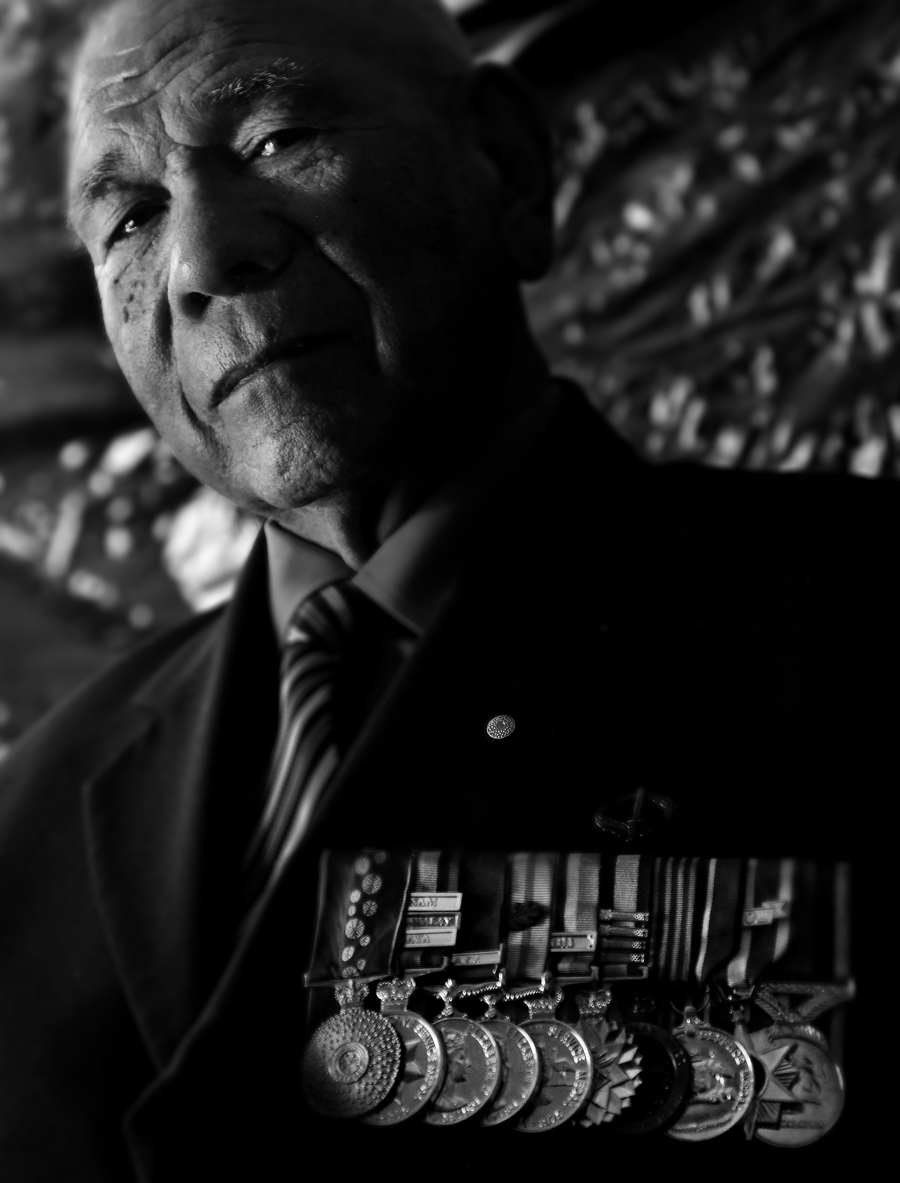
‘I went forward to check this place out and when I was moving forward I tripped a mine and it blew my leg off. If you are the leader of the push, if you go down, if things don’t work properly, you’ll all go down. You’ll all end up dead. It’s what you gotta do. You’re no good to them dead, you know, you’re no good to them dead. That’s it, it’s a fact of life. They say life is a death sentence and numerous reprieves, make the best of it.’
ROY MUNDINE OAM (MILITARY)
WEHBAL PEOPLE OF THE BUNDJALUNG NATION
RETIRED WARRANT OFFICER CLASS ONE
AUSTRALIAN ARMY
VIETNAM WAR VETERAN
INAUGURAL ELDER OF THE ARMY
‘On 25 April 1969, during Operation Surfside in Phuoc Tuy Province, Corporal Mundine was the leading Section Commander with 1 Platoon, A Company. On approaching a suspected enemy area, Corporal Mundine deployed his section on the ground and moved forward alone to reconnoitre the enemy position. He sighted enemy bunkers and was about to signal further instructions when he detonated a mine that severed his lower right leg and caused severe wounds to his back and his other leg. Members of his section started to move forward to come to his assistance, into what was later shown to be an enemy minefield. Corporal Mundine, although in considerable pain, ordered his section to stay out of the area and directed them to new fire positions after giving full details of the enemy bunker system. For over 40 minutes he continued to give instructions to his section and refused to allow any members of the platoon to move near him – until engineers had cleared a path through the minefield. This occasion was typical of his outstanding leadership. He was mentioned in dispatches in 1969. Roy received an OAM (Military) for his 36 years of serving with distinction in the armed services. His old battalion, the 5th Battalion, named a military operation in Afghanistan after him: ‘Operation Mundine’. Aboriginal and Torres Strait Islanders have served in virtually every conflict and peacekeeping mission from the Boer War to Afghanistan. In 1914, Aboriginal and Torres Strait Islander people could not vote and were not counted in the census. But once in the Australian Imperial Forces, they were treated as equals. They were paid the same as other soldiers and generally accepted without prejudice. After the war, in areas such as education, employment, and civil liberties, Aboriginal and Torres Strait Islander ex-servicemen and women found that discrimination remained. Many servicemen who returned now lie in unmarked graves, as their families were too poor to afford burial. Today, the Australian Government is assisting these families to right this wrong. Aboriginal and Torres Strait Islanders continue to serve in regular and reserve units.’
GARY OAKLEY, KAMILAROI MAN
INDIGENOUS LIAISON OFFICER, AUSTRALIAN WAR MEMORIAL
NATIONAL PRESIDENT, ATSI VETERANS AND SERVICES ASSOCIATION OF AUSTRALIA
Gary Oakley is the Indigenous Liaison Officer at Australian War Memorial and National President of the Aboriginal and Torres Strait Islander Veterans and Services Association of Australia (ATSIVSAA). Gary joined the Royal Australian Navy as a Junior Recruit in 1969. He later served as Petty Officer Marine Technical/Submarines on bases and on ships such as HMAS Perth, HMAS Stewart, HMAS Stalwart and the submarines HMAS Oxley and Ovens.